
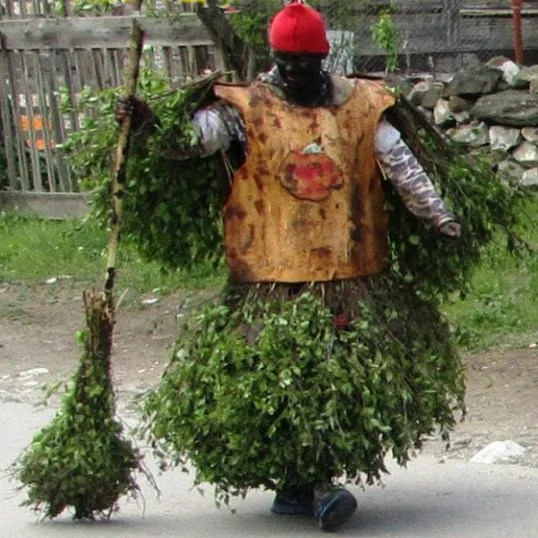
In the villages of Romania, customs that mark the beginning of the changing seasons throughout the year are still practiced. Among the most well-known of these rituals, also known as calendar customs, are the Paparudele. This tradition is practiced in Sângeorz, located in southern Transylvania and in the villages of the sub-Carpathian regions.
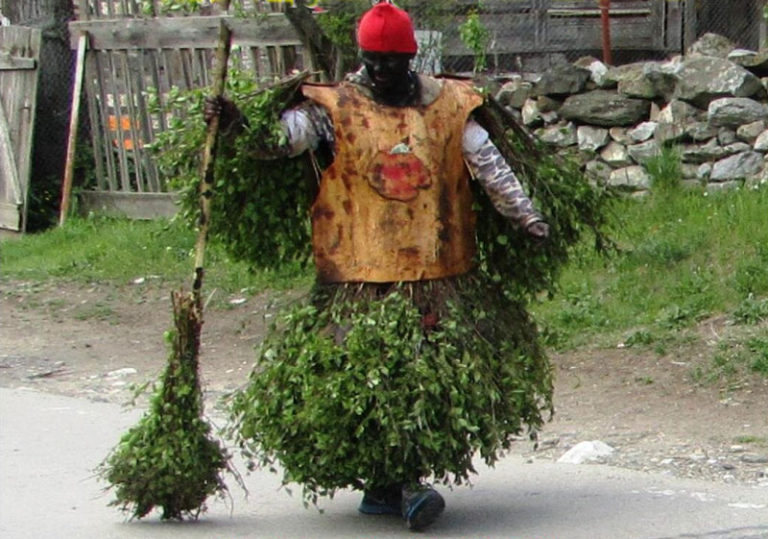
The category of Sângeorz customs includes processions with Păpărugi. During these processions, masked young people wear costumes made from leafy branches and tree bark. They announce the arrival of spring, a season symbolizing nature’s revival and the abundance expected with the harvest. The Păpărugi rituals are especially prominent in Sângeorz, during events like the Împreunatul or Măsurișul oilor, which take place annually on April 23. In some restricted areas, the Păpărugi processions occur during Ispas or Rusalii.
The disappearance of such rituals, many of which have roots dating back to times before the birth of Jesus, represents a process that has become increasingly visible, especially since the last decade of the previous century.
Distribution Area
In several versions, the tradition of Păpărugi or Păpălugarilor is still practiced only in some villages along the valleys of the Arieș and Someș rivers, as well as in a few localities in the Transylvanian Plateau.
The ceremonial practices of Sângeorz persist today in more isolated communities. For instance:
- In Limba, a village belonging to the commune of Ciugud, and Măhăceni, a locality within the commune of Unirea, both located in Alba County.
- In Muncel, a village in the commune of Cîțcău, and Buru, part of the commune of Iara, are both situated in Cluj County.
Unlike the processional forms of the Sângeorz tradition practiced in the other mentioned villages, where a single masked character goes carolling through the village (similar to Christmas), in Buru, a dramatized version of the custom has been preserved. This variant involves not just one, but six characters: four masked and one cross-dressed. All six characters are portrayed exclusively by men. Hence, there’s also a character played in cross-dress, known as Măriuța, the wife of Mutul Băbăluzii
Deployment
The rituals, which involve several stages, commence three days before the event. For instance, if Băbăluda is set to descend with her entourage into the village on a Monday, the practical ritual practices begin on Friday evening. From then until the day of the event, one of the two dobași (ritual leaders) climbs above the village of Buru. At the end of a sloping path where the Romans’ Road begins, they stop at a spot known locally as În Piatră (In the Stone). Perched on a rock, the dobaș announces the arrival of Băbăluzii through a trumpet. This ritual bears similarities to those practiced by shepherds during the celebration of Saint George, aimed at warding off strigoaicas (evil spirits) attempting to steal the sheep’s milk. It also resembles the rituals performed for the cows in the villagers’ households during the Împreunatul (Gathering).
After the first proclamation by the dobaș, preparations begin to ensure the necessary props for the procession led by Mutul Băbăluzii. In the second stage, the ritual involves obtaining wild cherry bark, which will be used to create Mutul’s vest and a cylindrical helmet that will fully cover Măriuța’s head. All six protagonists involved in the event’s performance take care of fulfilling these tasks and other duties specified in the ritual. For instance, during the 2019 edition of the custom, on Saturday afternoon, the actors playing roles in Băbăluda ascended to a small forest above the village, where they harvested wild cherry bark.
After carefully detaching smooth and hole-free bark from a tree, the young people preserve it by placing it in the water of the stream that flows through the village of Buru. They let it soak until the next day when the bark will be used for creating the costumes of the protagonists who will portray Băbăluda.
On the second day of preparations, around noon, the young people head back to the mountains to cut leafy branches from birch trees. These branches are used to make the skirts worn by the main characters, namely Mutul Băbăluzii and Măriuța, as well as the brooms, which are also part of the ritual props. This action begins at noon because it takes place on the first day of Easter. However, under different circumstances, the branches are cut later in the evening to prevent the leaves from wilting before the next day.
On the designated day (referred to as Z Day), preparations for the protagonists’ attire start in the morning. By noon, Mutul Băbăluzii and Măriuța, accompanied by their entourage, descend into the village to put into practice a tradition that has been observed in Buru for at least several hundred years. Up above the village, at a location known as Piatră or În Dos (traditionally established as the headquarters of Băbăluzii), experienced villagers join the preparations. They assist in creating the props, especially the skirts made from birch branches, and pay special attention to crafting Mutul Băbăluzii’s chest piece and Măriuța’s mask, where working with cherry bark requires skill and precision.
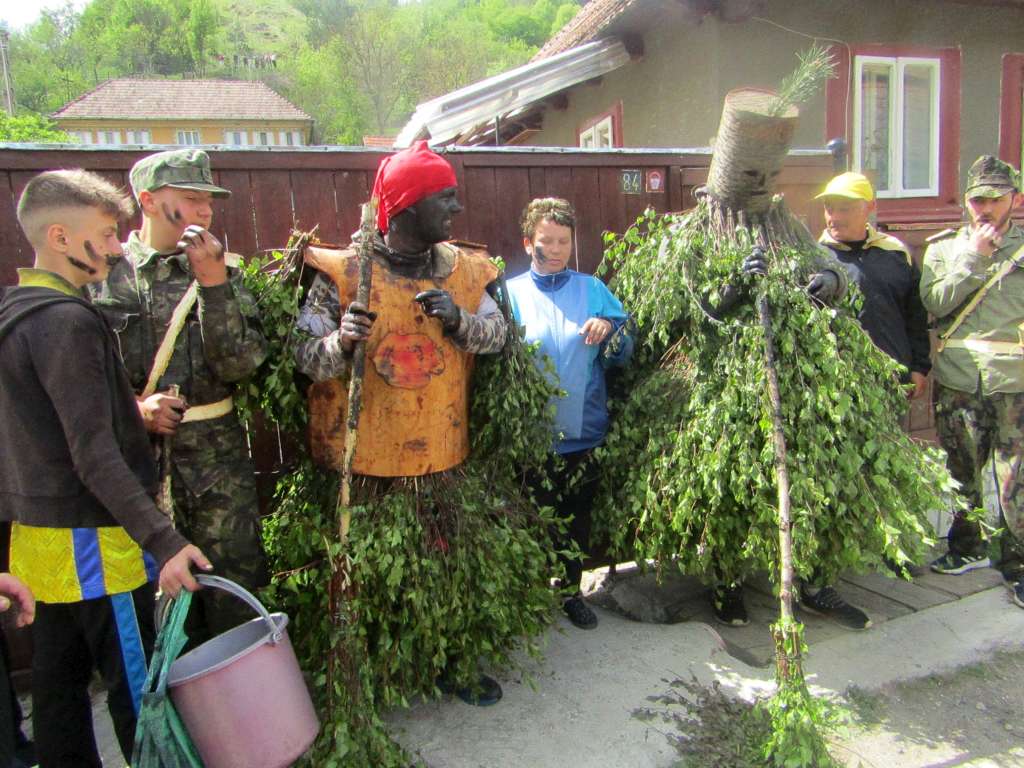
The first character to step into the scene, one of the dobași (ritual leaders), descends into the village immediately after gathering the protagonists at the headquarters. Clad entirely in black, their face smeared with a ritual cream concocted from pig lard mixed with soot, the dobaș announces in the village the imminent appearance of Băbăluzii and their entourage. The announcer smears the faces of adolescents and children they encounter along their path with the ritual cream. According to superstition, these individuals, marked by the mixture of pig lard and soot, become untouchable by malevolent spirits.
Magical Ointment with Protective Powers
A ritualistic ointment, somewhat similar to the one used in the Băbăluzii tradition in Buru, is prepared during the “Alesului” ritual practiced by shepherds in Banat and Transylvania. The similarities between Alesului and Băbăluda begin with the timing of the custom. Preparations commence on April 21, and the actual ritual takes place on April 23, coinciding with the celebration of Saint George, the Bearer of Victory. On the afternoon of April 21, women prepare sheep’s lard on the back of a chair or a clean board. Wrapped in cloth, this lard is given to shepherds so they have it before sunset. It is believed that at this moment, the strigoaicas (evil spirits) set out to steal milk from the unwashed sheep, marking the onset of all malevolent forces affecting the sheep.
The sheep’s lard is prepared from black pig fat, specifically taken from the heart of a sacrificial pig on Ignat’s Day, which falls on December 20. The lard intended for making the Sheep’s Ointment is not melted; instead, it is salted and preserved in a folded cloth, tied in a cross shape with the edges tucked inside. Afterwards, it is smoked in the hearth’s chimney. This well-preserved lard is then mixed, at the appropriate time, with garlic, dog’s milk, boz (a type of herb), lovage, wormwood, scai (elderberry), nettle, and willow or acacia leaves. Additionally, small dried and crushed flowers, collected on the 25th day between Easter and Pentecost (Rusalii), are added to the mixture. Shepherds believe that the plants in this concoction will keep evil away from the sheep and the flock.
The Spectacle
Before Mutul Băbăluzii and their entourage descend into Buru, the first dobaș (ritual leader), who is on duty before noon, traverses the distance between the Băbăluzii headquarters and the village several times.
The other characters, including Mutul Băbăluzii and his wife Măriuța, accompanied by two soldiers who guard them and another dobaș, arrive in the village on Saint George’s Day, around noon. A string of bells adorns the belts of Mutul and Măriuța, signalling to the village that Băbăluda is approaching. At least theoretically, the members of the Băbăludei group are not allowed to remove their masks until the end of the ritual, thus concealing their identities. This rule, now fallen into disuse, also appears in the ritual initiation ceremonies practiced in non-European tribal societies. These ceremonies involve seclusion in the forest, initiation trials, and masking—essential elements of the initiation scenario and dramaturgy.
The use of cherry bark extends to the attire of the soldiers, whose belts and diagonals are crafted from tree bark, similar to the epaulettes on their uniforms. According to some researchers of the Băbăluzii tradition in Buru, the inclusion of soldiers in the custom’s performance stems from the archaic social-cultural structure of pubertal initiations. This structure combines influences from the dominant society, particularly during the Austrian and Austro-Hungarian periods. These influences arise from the quasi-military nature of initiation rites practiced during the transition from adolescence to adulthood, as well as the institution of mandatory military service. This could explain the presence of certain military-inspired accessories in the clothing of some documented or still-existing variants of the Băbăluzii ceremony, such as belts and diagonals.
In the unique case of Băbăluzii, the procession of vegetal masks parades through the entire village, stopping at each gate. Here, Mutul Băbăluzii and Măriuța wield brooms crafted from leafy birch branches, meticulously sweeping the area. In return for their efforts, the hosts reward them with eggs. However, if the gates remain closed, the Băbăluzii troupe escalates the fences, heading straight to the chicken coops to collect eggs directly from the source.
Besides eggs, Mutul Băbăluzii and their entourage receive other gifts, including money. This latter form of payment is especially utilized by drivers of cars stopped along the national road between Turda and Câmpeni, a stretch that intersects the perimeter of Buru village. For drivers who refuse payment, Mutul Băbăluzii generously offers them a glimpse of the fertility symbol: a giant phallus carved from a thick birch branch, an integral part of their ritual attire.
Băbăluzii’s Immunity
During the celebration, the masked characters revel in complete freedom—a practical and virtually unlimited immunity. No one has the right to be upset with Mutul Băbăluzii, Măriuța, the guarding soldiers, or the dobași. However, if someone does get upset, they are not allowed to punish the performers for their actions. These actions can range from trespassing on private property by scaling fences surrounding houses to playfully splashing water or tossing people into the stream. This applies especially to girls, boys, or more spirited children if Băbăluda or someone from their entourage deems it necessary to carry out such antics.
In some villages, the immunity granted to participants in the Băbăluzi, Moroi, or Goțoi processions takes on a more aggressive tone. In cases where they did not receive the expected gifts, the Goțoii would swing their axes at gates and fence posts until they obtained what was owed to them. Alternatively, they would smear the walls of houses “because no law is mentioned against them”.
When leaving a household, Băbăluda often utters an auspicious formula, similar to Christmas and New Year’s greetings. This ritual is found in various versions of Băbăluda practiced in Deleni, Micești, Hășdate, and Buru, all located in Cluj County. Although most accounts do not explicitly mention the wording of the blessing, the mutual splashing with water—performed by both the characters portraying Băbăluda and the recipients—carries an implicit and potent auspicious value from a ritual perspective.
Adolescents Transition into the World of Men through “Piatră”
The Sângeorz ceremonial performed in Buru stages a ritual akin to Männerbünde. Coined by German folklorist Heinrich Schurtz in 1902, the term describes initiation rituals in East Africa. Männerbünde rituals signify a male covenant that holds legal power within strictly male associations, from which women are categorically excluded.
Around 10-15 years ago in Buru, young people preparing for Băbăluda spent the entire night at Piatră, a location above the village where the ancient Roman road began. They gathered around a fire, occasionally blowing horns. The interpreters of the ritual were usually chosen from those approaching the age of military conscription. Participation in Sângeorz marked the transition of Băbăludei performers from the social status of adolescents to that of adults. No woman was allowed in Piatră, where the interpreters prepared their costumes and ritual ointment. From there, the dobași would trumpet their calls across the village. The adolescents spent a sleepless night in the forest, only among themselves, by the fire. During that night, none of the participants were allowed to sleep, under the threat of severe corporal punishment.
The same unwritten law of male covenant, akin to Männerbünde, appears in certain vegetal mask ceremonies that still exist in Căianu Mare (in Bistrița-Năsăud County) or Codor (a village in the commune of Jichișu de Jos, near Dej, a municipality in Cluj County).
Will Băbăluda Die?
After a day that begins with preparations at Piatră and continues with the parade of Mutul Băbăluzii and their entourage through the village, the event concludes late in the afternoon with a communal bath in the stream. Once the characters who brought Băbăluda to life discard their masks and ritual costumes, the festivities kick off at a pre-designated host’s home. Taking center stage on the feast table is an omelette, a dish also known as papară or păpăraie, prepared from the several dozen eggs received by Mutu Băbăluzii and their group for their performance—a performance meant to protect the village from evil spirits until next year’s Sângeorz.
The declining population, estimated at 177 souls according to the 2011 census, with an ever-increasing average age, sets the stage for the disappearance of the Sângeorz tradition in Buru. The condition that Băbăludei performers must be young, aged 16 and above, and unmarried poses challenges in assembling the ritual’s cast. In Buru, fewer and fewer children reside, which means that soon the trumpet heralding Băbăludei’s arrival will no longer send its sharp cries down from Piatră over the village.
Bibliography:
- Bogdan Neagotă: “Pubertal Rites and Calendar Ceremonialization in the ‘Păpălugarii’ Complex of Transylvania. Ethnological and Historical-Religious Perspectives.”
- Romulus Antonescu: “Dictionary of Romanian Traditional Symbols and Beliefs”.
Article translated from http://www.ecouri.ro with http://www.bing.com
 Refugiu de Creație
Leave a comment